

If you’ve ever said “it’s faster if I just do it myself,” you’re not wrong. In the moment, it probably is faster. The problem is that every time you do it yourself, you’re trading today’s efficiency for tomorrow’s capacity.
Most business owners hit this wall eventually. The company grows to a point where the leader’s personal bandwidth becomes the constraint. Every decision runs through them. Every fire gets put out by them personally. Every new employee learns how things work by asking them directly.
The business doesn’t scale past what one person can touch. And the leader — who probably got here by being good at doing the work — can’t figure out why doing more of it isn’t fixing the problem.
The Perspective Gap
Part of what makes this so hard is that the leader and the team are operating with very different views of the same organization.
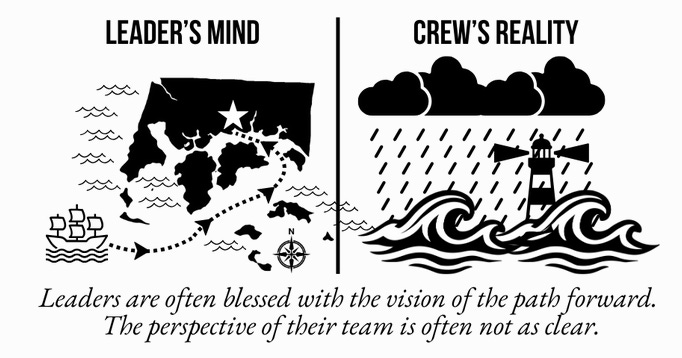
The leader has the full picture — the strategy, the relationships, the history of how things got to where they are. They can see the route from here to the destination. Their team often can’t. They’re navigating with limited visibility, incomplete information, and confusing signals. So they do the rational thing: they ask the boss.
Every question that lands on your desk is a symptom of this gap. And the instinct to just answer it — to jump in, solve the problem, and move on — is what keeps the cycle going. You’re not scaling yourself. You’re becoming the system.
Many business leaders are great at activity — the doing, the jumping in, the explaining (and re-explaining). However, it doesn’t scale. The results we get are symmetric to the time we invest, but that time is a limited resource.
Activity vs. Assets
I loved fishing when I was a kid. Baiting the hook, casting, waiting, retrieving, walking to the next spot — fish or no fish, there was always lots to do. Then someone gave me a fish trap. Add some bait, tie it to a tree, toss it in the river, come back the next day and collect your catch. Far less time, much less activity, many more fish.
Traditional fishing was an activity. Without my time and energy, there would be no fish. The trap was an asset — and with it, I could decouple the results from my constant involvement.
Most business owners are still fishing with a rod. Personally onboarding every new hire, attending every client meeting, manually checking the quality of every deliverable, answering the same questions week after week. These tasks feel productive, but if you stop doing them, nothing gets done. Your results are symmetric to your input — one hour in, one hour of output.
The alternative is building assets that produce results disproportionate to the effort required. An operations manual that answers questions without anyone asking you. An onboarding process that trains new hires without consuming your calendar. Templates, checklists, reference guides, automated workflows — things you build once that keep working whether you’re in the room or not.
To make the waters of our organizations more navigable, to create the conditions where more of our team can operate more often without our specific direction, we need the benefit to be asymmetric.
Making Your Organization Navigable
In Craft: The Expedition of Business, I use the story of the Lighthouse Board — the organization that transformed North Carolina’s “Graveyard of the Atlantic” from a ship-killing stretch of coastline into navigable waters. They didn’t do it by putting more captains on every ship. They did it by building the infrastructure that allowed competent sailors to navigate safely on their own: standardized buoys, distinctive lighthouses, comprehensive charts, and a published “Light List” that put every reference point in one accessible place.
The parallel to business is direct. Your team isn’t incompetent. They’re navigating without the infrastructure they need. And every time you step in to answer a question or make a decision they could have made themselves, you’re being the captain on their ship instead of building the lighthouse.
The Lighthouse Board’s approach rested on principles that apply to any organization trying to become more self-sufficient:
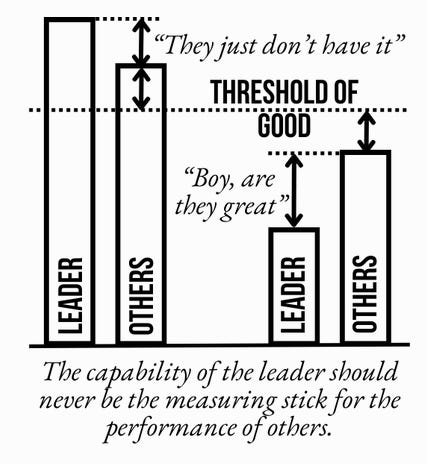
Define what qualifies as a “good” decision. The default benchmark in most organizations is “what would the leader have done?” That’s the wrong measuring stick. A good decision is one where the person used reasonable judgment and sought out the tools and information available to them. If they did that and the result was still wrong, the problem isn’t the person — it’s the system.
Reduce the number of decisions to be made. Every decision that can be eliminated by a template, a default setting, a checklist, or an automated workflow is one less opportunity for things to go wrong — and one less question on your desk. The Lighthouse Board’s first act was standardizing the buoy system. One simple rule — “red right returning” — eliminated thousands of judgment calls for ship captains approaching unfamiliar harbors.
Make ownership clear. When everyone is responsible for everything, no one is responsible for anything. The Lighthouse Board assigned one person at every level — one district inspector per region, one keeper per lighthouse, one station keeper per stretch of beach. No ambiguity about who owned which decisions.
Provide clear reference points. The Lighthouse Board created the “Light List” — one published source containing everything a captain needed to navigate the coast. Not six documents scattered across different drawers. One book, regularly updated, available at every port. In my company, we had the same: an Operations Manual that served as the single trunk from which every other document branched. If someone needed information, they knew where to look.
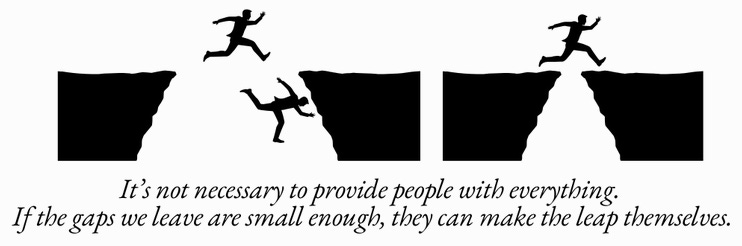
The Communication Trap
There’s a related problem that keeps leaders stuck as the bottleneck, and it’s counterintuitive.

While good communication is undoubtedly an asset, the need for good communication is a liability.
Every conversation required, every message that must be sent, every meeting that wouldn’t be needed if the system was designed differently — these are all points of failure. And every one of them tends to flow through the leader.
The answer isn’t “communicate better.” It’s to reduce the need for communication in the first place. When your organization has clear reference points, documented processes, and defined ownership, entire categories of communication become unnecessary. People stop asking because the answer is already available. Updates stop requiring meetings because dashboards show the status. New hires stop needing weeks of hand-holding because the onboarding system does the heavy lifting.
Every asset you build eliminates conversations that would otherwise require your involvement. And the time you save goes into building the next asset. It becomes a flywheel — more infrastructure leads to more independent decisions, which frees up more of your time to build better infrastructure.
The Ecosystem, Not the Machine
This is where the bottleneck conversation connects to something deeper. Most business owners think about scaling as adding capacity — more people, more hours, more resources. That’s the mechanical approach, and it works up to a point. But machines require constant input. They run down. They need someone to keep cranking.
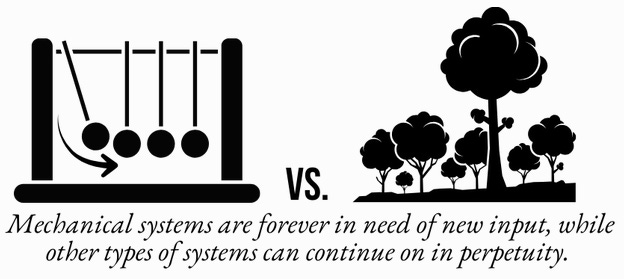
The alternative is building an ecosystem. When the right systems are in place and people have what they need to navigate independently, something shifts. The business stops requiring your constant input and starts generating its own momentum. People don’t just complete tasks — they find better ways to do them. They solve problems you didn’t know existed. One person’s improvement becomes the team’s new standard.
That’s asymmetric output. An hour spent building a reference guide doesn’t just save you one future conversation — it saves hundreds. A clear ownership structure doesn’t just prevent one dropped ball — it prevents a pattern of confusion that would have consumed your attention for months.
The leader who builds these systems isn’t less involved. They’re involved differently — at a higher level, on higher-value problems, with a team that’s capable of handling everything else. That’s what scaling actually looks like. Not doing more, but building the conditions where your organization does more without you having to push.
The business may not become a true perpetual motion machine. But it can become what most business leaders want: an organization that is more self-managing. And one that makes the efforts and inputs of its leaders more discretionary than mandatory.
The principles of building navigable waters for your team — along with the systems for navigation, communication, supply lines, and strategic pauses that keep an organization on course — are covered in Part 4 of Craft: The Expedition of Business.