

“Business is hard enough even if we assume everyone is operating in the same reality. When everyone perceives the same information in different ways, it gets that much more difficult. Unfortunately, we tend to overestimate how often we’re on the same page.”
The below is an excerpt from Part 2 - Chapter 6 of “Craft: The Expedition of Business”:
“Mr. Tomlin, I’ve been trying to reach you for weeks. I’m out of patience and am turning this issue over to my attorney.”
It wasn’t the voicemail I wanted to find when I returned from lunch, nor was it a message that I could make much sense of. I knew the number and the voice. He was a client, and two or three weeks prior we had met to resolve an issue on a project. A meeting that I thought had put matters to rest. I had not heard from him since. I was as much perplexed as concerned.
My return call keyed me in on a few pieces of information. He had my email address wrong, those messages I had “ignored” never made it to me. His phone calls that I “didn’t return”—until that day they never ended with a voicemail. I did not know that he had called.
Now I had clarity on the “out of patience” part of his message, but “my attorney”? I thought this was resolved. It turns out he did too—until he talked with his boss. He had different ideas as to who bore responsibility.
The entire episode had started months prior when they contracted us to provide some design services. They presented “what they had budgeted” to my project manager, and my project manager saw his task as giving them the design “they asked for.”
I’m not sure the client disagreed until the piece of equipment didn’t work. “We should have raised our concerns” was my take on the situation, but I was still unclear on just what had happened.
There was much to understand. Why the voicemail? How did this design come to be? Why the change of heart? It took a while, but once I could understand everyone else, I could finally be understood, and a resolution could be reached.
Understanding is also the first step in getting people aligned within an organization. What is their starting point? What is their perception of reality? Those are the foundations needed to build a usable model. One that explains what someone might want and how they are likely to respond. Without that foundation, the world can be a strange, confusing, and frustrating place.
You’re probably familiar with the classic party game “Telephone.” Someone starts the game by whispering a message to the person next to them. That person does the same, and by the time you’ve reached the end you’re left with some altered version of the original message.
A more modern take on the game, and a better analogy for our struggles related to perception, is the game Telestrations®. In that game, players alternate between drawing a picture of the “secret word” and writing a description of the previous player’s drawing.
As you might imagine, hilarity often ensues. What started as “A rabbit wearing a top hat” turns into “Richard Nixon taking a bubble bath.” Unfortunately, with business and getting our teams aligned, we often get the confusion but rarely the comedy.
There is no “secret word” in business. Instead, we’re awash in information: calls, emails, tone, body language, and there’s more. At any moment we’re also processing our entire field of view: the sounds around us, the feeling of the air and objects we’re in contact with, and whatever smells our noses may be picking up.
In effect, all that incoming information is the world and our immediate place in it. To keep it from being overwhelming, our brains filter out nearly all of it. What we’re left with is the small slice we focus on: our attention. What we pay attention to gets filtered through our perception of the information we are aware of.
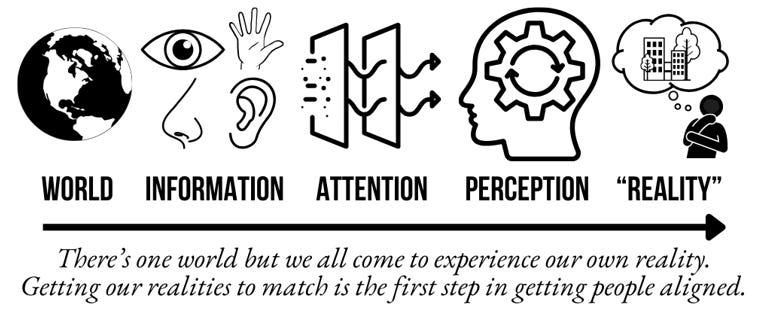
Without attention and perception, it would all be noise. With it, we create a mental model to approximate reality. We can’t absorb all of reality at once, so we develop a low-resolution view to make sense of that small slice of reality we pay attention to. And that perception becomes one’s reality.
Unfortunately, in business, this chain of approximations often becomes our own game of Telestrations®, and it’s not as much fun.
Like me, you receive an angry phone call from a customer. Now the words they say didn’t fall from heaven. They start as the customer’s perception, a product of the slice of reality they paid attention to. Maybe they’re right to be upset, maybe they’re not; but in the moment, their approximation of reality takes shape in their mind, and the resulting action is to give you an earful.
They then make yet another approximation. They can’t express 100% of what they’ve experienced, how they feel, and what they want you to do about it. That all exists in their head, but to convey it to you they’re left to approximate the best they can. They do so with words, their tone of voice, and maybe—if they still have a landline—slamming their phone down.
So now it’s your turn. You’ve paid attention to some slice of the information sent screaming at you. You’ve perceived it the best you could, constructed your own approximation of reality, and now you must do your best to approximate the situation to an employee who can fix it. An employee who is the next link in the chain of “world”, attention, perception, and action.
With each step, the picture, the “reality”, our communication, and expectations all drift further from the truth of the situation.

Business is hard enough even if we assume everyone is operating in the same reality. When everyone perceives the same information in different ways, it gets that much more difficult. Unfortunately, we tend to overestimate how often we’re on the same page.
Research has shown that nearly 60% of us overestimate how effectively we communicate. And it’s a problem in both directions. A person communicating with you is likely to assume they’ve delivered a clearer message than they have, and you’re likely to err in the same direction about your communication with someone further down the chain. It’s how we get from Peter Rabbit dressed for a night on the town to the 37th President taking a dip in the tub. And it’s how we find ourselves befuddled over what “made sense to us.”
There’s a long list of what makes getting others to share our version of reality difficult: our varied histories and past experiences, words and their multiple meanings, the non-verbal cues that can enforce but also derail our messages, our tendency to fill gaps in information with assumptions or our memories, and that we all are likely to focus our attention on different pieces of information.
Some people spend a career researching all the different factors that influence our specific perception of reality. But for a business leader, one question is essential: “What do I do about it?”
Thankfully, there’s a four-step process that can help us make sense of things.
R.E.A.R.
Relate to their perspective. Explore what they think is happening and why. Affirm your understanding by repeating back. And then, but only then, Respond....
When’s the last time you found others living in a different reality? With the right steps, you can likely bridge the gap.
Learn more about my new book at: TheExpeditionofBusiness.com